Dubai and the wider UAE are among the most crypto-friendly places anywhere, yet the everyday question stays the same: how do you actually spend the USDT sitting in your wallet? Your salary arrives in AED, your bank card is AED, and your bank may or may not like transfers from an exchange. A crypto card closes that gap. This guide compares the main options available to UAE residents and visitors in 2026, including the Crypto.com Visa card, exchange cards from Binance and Bybit, the Nexo card and bank-issued cards, and explains where a no-KYC USD card such as IZIPAY fits. One note before we start: regulations and provider availability in the UAE change often, so treat everything below as a starting point and verify the current terms with each provider before you commit money.
Why crypto cards are popular in the UAE
The UAE is one of the most crypto-friendly jurisdictions in the world, and that shows in day-to-day behaviour. Dubai has its own regulator for virtual assets, VARA (the Virtual Assets Regulatory Authority), which licenses exchanges and custodians in the emirate. At the federal level the Securities and Commodities Authority (SCA) sets rules for virtual asset service providers, and the financial free zones ADGM in Abu Dhabi and DIFC in Dubai run their own frameworks for regulated crypto businesses. The result is a market where a meaningful share of residents hold digital assets.
Two more things drive card demand. First, there is no personal income tax in the UAE, so many residents receive part of their income, bonuses or freelance payments in stablecoins and prefer to keep them in USDT rather than convert everything to dirhams. Second, salaries and bank cards are AED-based, and banks vary widely in how they treat transfers to and from crypto exchanges: some process them without comment, others delay or decline them. A card that spends crypto directly avoids the off-ramp entirely.
Typical use cases we see from UAE customers:
- International subscriptions and software billed in USD, including AI services.
- Funding ad accounts on Meta, Google or TikTok for Dubai agencies and e-commerce sellers.
- Booking flights and hotels on international sites that price in USD or EUR.
- New expats without a local bank account yet, which can take weeks to open.
- Freelancers and remote workers paid in USDT by overseas clients.
- Privacy, meaning a separate card for online purchases that is not linked to the main bank account.
What to look for in a crypto card in Dubai
Not every card that calls itself a "crypto card" fits the UAE. Before comparing brands, decide what matters to you on these criteria:
- KYC requirements. Exchange-linked cards require full identity verification, often with proof of address, and sometimes a residency check. No-KYC cards need an email only.
- Issuance time. Ranges from minutes for a virtual no-KYC card to days or weeks for a card that needs verification and a physical delivery.
- Top-up assets and networks. Which coins can you load, and on which chains? Tron USDT is the cheapest way to move stablecoins; Ethereum is the most expensive.
- Monthly and hidden fees. Look at the issuance price, monthly or inactivity fees, top-up or conversion spread, and the foreign exchange markup on AED purchases.
- Apple Pay and Google Pay. Contactless is the default at almost every Dubai terminal; a card that cannot go into a phone wallet is much less useful offline.
- Physical card. Needed for ATMs; optional for most online-first users.
- Currency of the card. Most crypto cards are denominated in USD or EUR. Paying in AED means a card scheme conversion, which is usually small but not zero.
- Who it suits. A card built around cashback and staking suits a long-term exchange user. A card built around speed suits someone who needs to pay an invoice tonight.
Comparison table: crypto card options for the UAE
The table is qualitative on purpose: fees and availability at exchange-linked providers change often and depend on your tier, so check each provider's current terms.
| Card | KYC | Issuance time | Top-up assets | Monthly fee | Apple Pay / Google Pay | Physical card | Best for |
|---|---|---|---|---|---|---|---|
| IZIPAY (virtual, USD) | None, email only | About 2 minutes | USDT on Tron, Ethereum, BNB Chain, Polygon | None, one-time price | Yes, on the Apple Pay Mastercard | Metal card available | Fast issuance, no documents, online spending |
| Crypto.com Visa | Full KYC, plus CRO staking for higher tiers | Days to weeks, depends on tier and region | Crypto.com app balance | Depends on tier, check current terms | Typically yes where available | Yes, tiered | Existing Crypto.com users who want cashback |
| Binance card | Full KYC | Days, if available in your region | Binance spot balance | Check current terms | Where supported | Depends on region | Active Binance traders |
| Bybit card | Full KYC | Days, if available in your region | Bybit account balance | Check current terms | Where supported | Depends on region | Active Bybit traders |
| Nexo card | Full KYC | Days | Nexo balance, credit or debit mode | Check current terms | Where supported | Yes in some regions | Users who borrow against crypto |
| Bank-issued AED card | Full bank onboarding, Emirates ID | Weeks after account opening | AED only, after selling crypto | Often an annual fee | Yes | Yes | Everyday AED spending, salary |
The exchange-linked cards (Crypto.com, Binance, Bybit, Nexo) share one model: verify your identity with the exchange, keep a balance there, spend it through a card. They can offer cashback, but availability by region moves around, and a UAE resident accepted today may find the product paused later. The bank card is the opposite: stable and fully AED, but it never touches crypto; you sell on an exchange and withdraw first. IZIPAY is a third category: a prepaid USD card funded directly with USDT, no exchange account, no documents, no cashback, no AED balance.
Crypto.com card in the UAE: availability and requirements
"Crypto.com card UAE" is a common search, so it deserves a direct answer. Crypto.com's Visa card has historically been available in a limited set of regions and expanded in stages. Card availability for UAE residents has been limited or rolled out gradually rather than open to everyone from day one. We are deliberately not asserting availability for your specific case, because eligibility depends on residency status and the current rollout. The reliable way to check is inside the Crypto.com app: open the card section and see whether your account is offered a card.
If it is offered, expect the standard requirements:
- Full KYC with the exchange, meaning passport or Emirates ID, a selfie and often proof of address.
- Tier selection. The entry tier usually has no staking requirement, while higher tiers with better cashback require staking CRO, Crypto.com's token, for a lock-up period. Rates change, so read the current tier table in the app.
- Funding from your Crypto.com balance, so your crypto sits with the exchange rather than in your own wallet.
- A physical card shipped to a UAE address, with a virtual card usable earlier in some tiers.
It is a reasonable choice for an active Crypto.com user who wants cashback and accepts the staking lock-up, and a poor fit if you need a card today or do not want exchange KYC.
Best no-KYC option for Dubai: IZIPAY
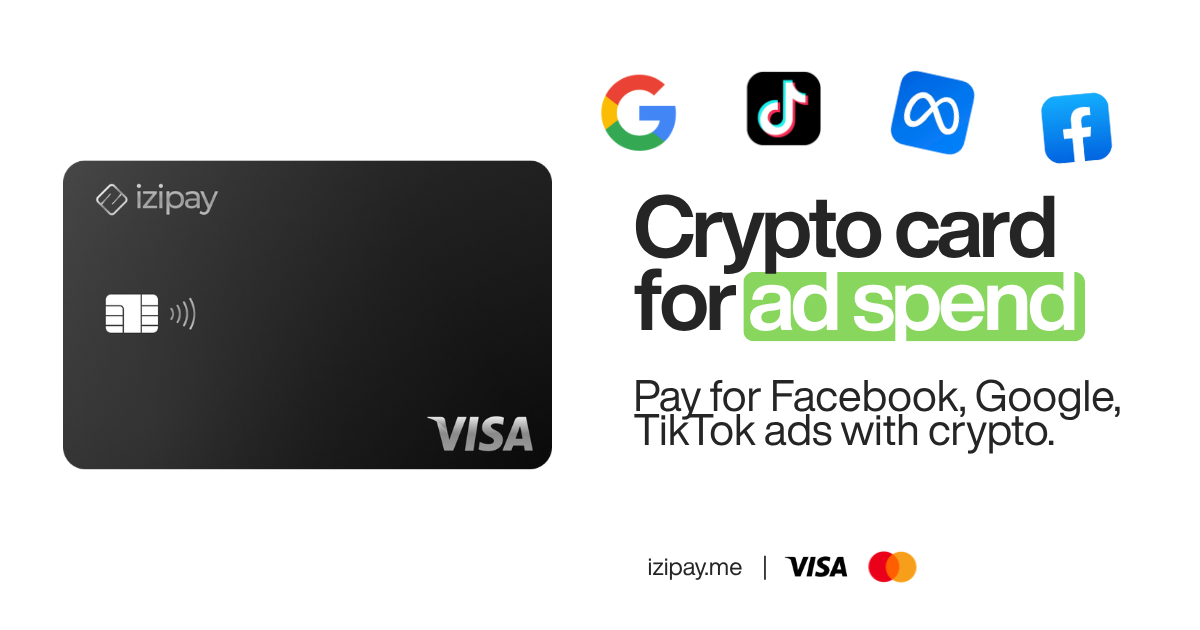
If your priority is speed and minimal paperwork, IZIPAY is the fastest option we know of for UAE users. It is a prepaid virtual card denominated in USD, issued in about two minutes, funded with USDT, and registered with an email address only.
What you get:
- A virtual debit card at a one-time price: the Visa for AI tools and advertising at $49.99, the Apple Pay Mastercard at $59.99, which works in Apple Pay and Google Pay.
- A physical metal card at $459.99 for people who want ATM access and a card to hand over in person.
- No monthly fee and no inactivity fee.
- Top-ups in USDT on Tron, Ethereum, BNB Chain and Polygon at 3% plus the network fee.
- Card details delivered in the dashboard and by email, with support available 24/7.
What you do not get, and it is fair to say so: IZIPAY is not a bank account, there is no cashback, there is no AED balance, and you cannot receive salary transfers onto it. It is a spending tool for crypto, nothing more.
Step 1: register with an email
Go to the registration page, enter an email address and set a password. There is no form asking for your name, address or documents.
Step 2: choose the card and pay in USDT
Pick the Apple Pay Mastercard for tap-to-pay in Dubai, or the Visa for online purchases, AI subscriptions and ad accounts. Pay the one-time price in USDT; Tron is usually the cheapest network.
Step 3: receive the card details
Within about two minutes the card number, expiry date and CVV appear in your dashboard and arrive by email. The card is live immediately.
Step 4: top up and spend
Send USDT to the top-up address shown for your card. The balance appears in USD after network confirmation. Add the Mastercard to Apple Pay or Google Pay following our guide on how to add a crypto card to Apple Pay, or use the card details directly at online checkouts.
Fees explained with a worked example
The cost structure has three parts: the one-time issuance price, the 3% top-up fee, and the network fee charged by the blockchain you use. There is no monthly or inactivity charge.
Worked example. You want to load $500 onto the card using USDT on Tron.
- Top-up fee: 3% of $500 = $15.
- Network fee: roughly $3 on Tron at the time of writing (it varies with network conditions; Polygon and BNB Chain are usually in a similar range, Ethereum is higher).
- Total sent: $500 + $15 + $3 = $518.
- Balance on the card: $500.
So the effective cost of that top-up is $18, or about 3.6% of what lands on the card. On a $1,000 top-up the network fee stays about the same, so the effective rate drops toward 3.3%: fewer, larger top-ups are cheaper.
Compare this to the off-ramp path: sell USDT on an exchange (trading fee), withdraw AED to the bank (withdrawal fee, plus the chance the transfer is questioned), then pay a USD merchant with an AED bank card (foreign exchange markup). More fees, and days instead of minutes. See the full pricing page for current numbers.
Using the card in Dubai and abroad
Online purchases in USD. The card is in USD, the merchant charges in USD, no conversion at all. Subscriptions, ad platforms, hosting, international booking sites and most SaaS tools fall here.
Paying in AED at a Dubai merchant. When a merchant charges in AED, the card scheme (Visa or Mastercard) converts the amount to USD at its wholesale rate. Because the dirham is pegged to the dollar, the rate is stable and the conversion cost is small but not zero. If a terminal offers to charge you in USD instead of AED, that is dynamic currency conversion, and it is usually worse than letting the scheme convert; choose AED.
Apple Pay and Google Pay. The Apple Pay Mastercard can be added to a phone wallet, so tap-to-pay works at contactless terminals across the UAE, from a Deira grocery to a DIFC restaurant. The Visa for AI and ads is intended for online use.
ATMs. Cash withdrawal requires the physical metal card; virtual cards cannot be used at ATMs, and UAE ATM operators add their own fee.
Travel abroad. The card works wherever Visa or Mastercard is accepted, and in eurozone or UK shops the same scheme conversion applies, from EUR or GBP into USD.
Risks and tips
- Verify availability yourself. Regulations and provider availability change; check the app or the provider's website on the day you sign up.
- Send USDT on the right network. If the card shows a Tron address, send Tron USDT. Sending on a different chain to the same address is the most common way people lose time and, sometimes, money.
- Prepaid means prepaid. Only what you load is available; check the balance before a large booking.
- Merchant declines happen. Some merchants block prepaid or foreign-issued cards; if a checkout fails, contact support, available 24/7.
- Keep records. Even without personal income tax in the UAE, you may have reporting obligations in your home country. A prepaid card does not change that.
- Do not treat a card as a bank. For salary, rent and savings you still need an AED bank account; the crypto card handles the USD-denominated part of your spending.
For a broader look at no-KYC options beyond the UAE, see our guide to the best crypto card without KYC in 2026. For the full spend-anywhere workflow, read how to pay for anything with crypto using a no-KYC card.
Conclusion
There is no single best crypto card for everyone in the UAE. If you already keep funds on Crypto.com, Binance, Bybit or Nexo, have completed their KYC, and want cashback, the card from that exchange is worth checking, once you confirm it is currently offered to UAE residents. If you want dirhams and a salary account, a bank card is the only real answer. If you want a USD card in your hands in two minutes, funded with USDT from your own wallet, with no documents and no monthly fee, IZIPAY is the straightforward choice.
Ready to try it? Register with an email, pick the Apple Pay Mastercard or the Visa, and your card details arrive in about two minutes.