IZIPAY vs Crypto.com Card: Fees & KYC Compared (2026)
The Crypto.com Visa Card is one of the best-known crypto cards on the market. It is backed by a major exchange, the card itself costs nothing to order, and the top-up fee is low. On a spreadsheet it looks hard to beat.
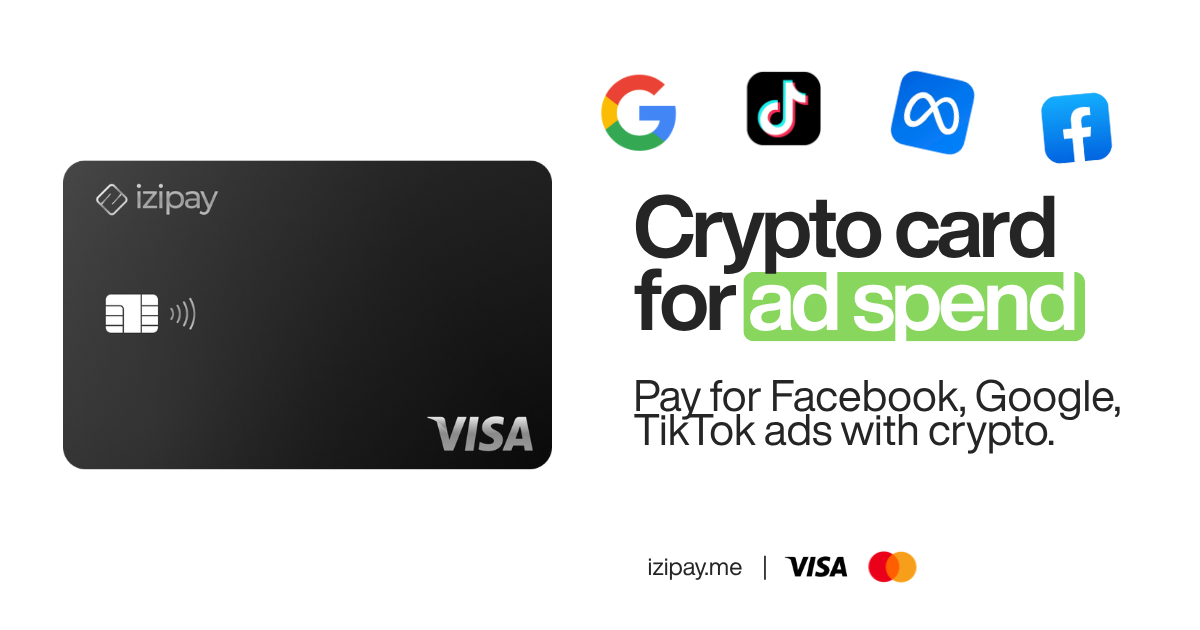
IZIPAY is a different animal: a standalone virtual Visa you open with an email address, fund with stablecoins, and use anywhere Visa is accepted - no identity documents, no exchange account, no tokens to lock up.
The honest framing is not "which card has the lowest fee." It is "which card will actually work for you, and what does the whole thing cost once you count the parts that are not on the fee page." Crypto.com wins the headline top-up number. It also asks for things IZIPAY never asks for, and it charges people who stop using it. Both of those are real costs.
All Crypto.com fees below are accurate as of July 2026 and are set by Crypto.com, not by us. Card programs revise pricing, tier structures and staking requirements regularly - verify the current fee schedule and tier table before you commit money.
Quick verdict
Choose the Crypto.com Card if you live in a supported region, you are comfortable completing full identity verification, you already hold or are willing to stake CRO, and you will use the card consistently. On the top-up fee alone it is cheaper than IZIPAY - 1% versus our 3% - and for a steady monthly spender that difference compounds.
Choose IZIPAY if any one of those conditions fails. No KYC, no exchange account, no staking, no regional gatekeeping, and no penalty for letting the card sit idle. You pay more per dollar loaded, and that premium buys access and privacy that the cheaper card does not sell at any price.
The short version:
- Lowest top-up fee: Crypto.com Card (1% vs our 3%)
- No identity verification: IZIPAY
- No inactivity penalty: IZIPAY (Crypto.com charges $4.95/month after 12 months of no use)
- No token staking required: IZIPAY
- No exchange account required: IZIPAY
- Works outside supported regions: IZIPAY
- Best for heavy, consistent monthly spend: Crypto.com Card
Full comparison table
| IZIPAY | Crypto.com Visa Card | |
|---|---|---|
| Issuance fee | $49.99 one-time (virtual) | Free to order |
| Staking required | None | Better tiers require staking CRO |
| Monthly fee | $0 | $0 |
| Inactivity fee | None, ever | $4.95/month after 12 months of no use |
| Top-up fee | 3% (crypto funding) | 1% (crypto or fiat) |
| Per-transaction fee | None | None |
| Foreign transaction fee | No per-transaction fee | 2% outside USD/EUR/GBP; 0.2% for EUR/GBP |
| ATM withdrawals | Not applicable (virtual card) | 2% after the monthly free limit |
| KYC / ID documents | Not required for standard individual use | Mandatory identity verification |
| Exchange account required | No | Yes, a Crypto.com account |
| Funding networks | USDT (TRC20/ERC20/BEP20), USDC, BTC, ETH, SOL, BNB, MATIC, TON | Crypto or fiat via the Crypto.com app |
| Mobile wallets | Apple Pay, Google Pay | Apple Pay, Google Pay |
| 3D Secure | Yes | Yes |
| Availability | No regional gatekeeping | Supported regions only |
Total cost of ownership: three worked examples
Fee tables mislead because they price one action, not one year. Here is what each card actually costs across a realistic year.
The heavy spender: $1,000/month, every month
- Crypto.com: $12,000 loaded at 1% = $120/year. Card is free. No inactivity fee, because the card is in constant use.
- IZIPAY: $49.99 one-time + 3% of $12,000 = $360 = $409.99 in year one, $360/year after.
Crypto.com wins, decisively. If you qualify for it and you spend at this level, the lower top-up fee is the whole ballgame and no amount of framing changes that. Use the cheaper card.
The moderate spender: $200/month
- Crypto.com: $2,400 at 1% = $24/year.
- IZIPAY: $49.99 + 3% of $2,400 = $72 = $121.99 in year one, $72/year after.
Crypto.com still wins on price. The gap narrows in absolute dollars but the ratio holds.
The occasional user: loads $500, uses it, then goes quiet
This is where the numbers invert, and it describes far more cardholders than the industry likes to admit - people who order a card for a specific purpose, use it for a few months, and then leave it alone.
- Crypto.com: $5 top-up fee on $500. Card sits unused. After 12 months of no activity, the $4.95/month inactivity fee begins. A second dormant year costs $59.40, drawn straight out of whatever balance is left. Leave it long enough and the fee eats the remainder.
- IZIPAY: $49.99 + $15 top-up = $64.99, and then nothing. The card can sit untouched for years. There is no maintenance fee, no dormancy fee, no monthly charge of any kind.
By roughly the fourteen-month mark of dormancy, the "free" card has stopped being free and started billing you monthly for the privilege of not using it. That is not a gotcha we invented for marketing purposes - it is a published line item, and it is the single clearest case where IZIPAY is simply cheaper.
The costs that never appear on a fee page
Two more items belong in any honest total-cost calculation:
Staking. Crypto.com's more attractive tiers - the ones with better rebates and higher free ATM limits - require locking up CRO. That capital is committed, exposed to the token's price, and unavailable to you while staked. Whether you call it a fee or an opportunity cost, it is money that is not in your pocket. IZIPAY has no staking requirement and no token.
Onboarding. Full KYC takes time, sometimes several rounds of document resubmission, and sometimes it simply ends in rejection. A card you cannot get approved for has an infinite effective cost. IZIPAY needs an email address.
KYC and privacy
This is the sharpest difference between the two products, and it is binary rather than a matter of degree.
Crypto.com requires full KYC. Identity verification is mandatory - government ID, and the usual document and selfie checks that come with a regulated exchange account. You also need a Crypto.com account before you can hold a card at all, which means your card is downstream of your exchange relationship. If the account is limited or closed, the card goes with it.
IZIPAY requires no KYC for standard individual use. Sign up with an email address, fund from your own wallet, spend. No passport upload, no proof of address, no selfie, no waiting on a review queue. There is no exchange account sitting underneath the card that can be frozen out from under you.
The practical consequences go well beyond privacy preference:
- You are in an unsupported region. Crypto.com's card is limited to supported markets. No amount of documentation fixes a geographic restriction. IZIPAY has no such list.
- Your documents are awkward. Recently moved, no utility bill in your name, a passport that scans badly - routine situations that stall verification for weeks.
- You want spending separated from your exchange identity. A card tied to a verified exchange account links every purchase to that identity by design.
- You need a card today. Verification queues take as long as they take.
If you want a deeper treatment of the no-document approach, see the best no-KYC virtual crypto card and our guide to paying for anything with a no-KYC crypto card.
Checkout reliability and card BINs
A card that gets declined at checkout has no fee advantage, because the transaction never happens.
The BIN - the first six to eight digits - tells the merchant's payment processor what kind of card it is: which bank, which country, prepaid or credit, consumer or commercial. Risk engines lean on it heavily. Cheap consumer prepaid BINs, especially ones associated with high chargeback volume, get treated with suspicion by strict processors. Stripe-based subscription checkouts are among the strictest.
IZIPAY issues on premium commercial BINs that clear Stripe checkouts. In practice that means the services people most often fail to pay for with a crypto card - ChatGPT, Claude, and the major advertising platforms - go through. Combined with 3D Secure support and Apple Pay / Google Pay, the card behaves like an ordinary business card at the point of sale, because from the processor's perspective it is one.
Crypto.com's Visa card is a mainstream, widely accepted product and generally performs well at checkout. This is not a category where it fails - it is one where IZIPAY is deliberately built for the strictest processors rather than for general retail.
Who should choose which
Choose the Crypto.com Card if:
- You live in a supported region and will pass KYC without friction
- You spend meaningfully every month, so the 1% top-up beats a 3% one
- You already hold CRO, or you are happy to stake it for a better tier
- You want ATM access from the same card
- You are comfortable with your card depending on an exchange account
Choose IZIPAY if:
- You do not want to submit identity documents, for any reason
- You are outside Crypto.com's supported regions
- You will use the card occasionally and refuse to be billed $4.95/month for the quiet periods
- You do not want to lock up tokens to get decent terms
- You want a card that exists independently of any exchange
- You need a card that reliably clears Stripe-based checkouts
- You want a predictable, front-loaded cost: pay once, then only the top-up fee
Consider both. They are not mutually exclusive, and plenty of people run a low-fee exchange card for routine monthly spending alongside a no-KYC card for everything the first one cannot or will not do.
If you are still weighing the field, compare IZIPAY vs RedotPay and IZIPAY vs the Bybit Card, or read our overview of which crypto debit card is best.
The bottom line
Crypto.com has the lower top-up fee, and if you qualify for the card and use it steadily, that is the correct choice. We are not going to pretend otherwise - a 1% fee is cheaper than a 3% fee, and readers can check that in ten seconds.
What Crypto.com asks in return is a verified identity, an exchange account, a supported address, CRO staked for the good tiers, and continued use or a $4.95 monthly penalty. For a large number of people, one or more of those is a hard blocker rather than an inconvenience.
IZIPAY exists for exactly those people: $49.99 once, 3% to top up, and then nothing - no monthly fee, no maintenance fee, no inactivity fee, no documents, no staking, no exchange account, no region list.
Ready to start? Get your IZIPAY virtual card or open an account at izipay.me and fund it with USDT in minutes.