Best Crypto Card Without KYC in 2026 (No ID Required)
Tired of crypto cards that demand your passport, address proof, and a selfie just to let you spend your own money? You're not alone. In 2026, privacy-conscious crypto users are actively searching for one thing: a crypto card without KYC.
This guide compares the best no-KYC crypto cards available in 2026, explains how they actually work, and helps you choose the right one. We'll cover real options that let you spend Bitcoin, USDT, and Ethereum anonymously — without sacrificing usability or security.
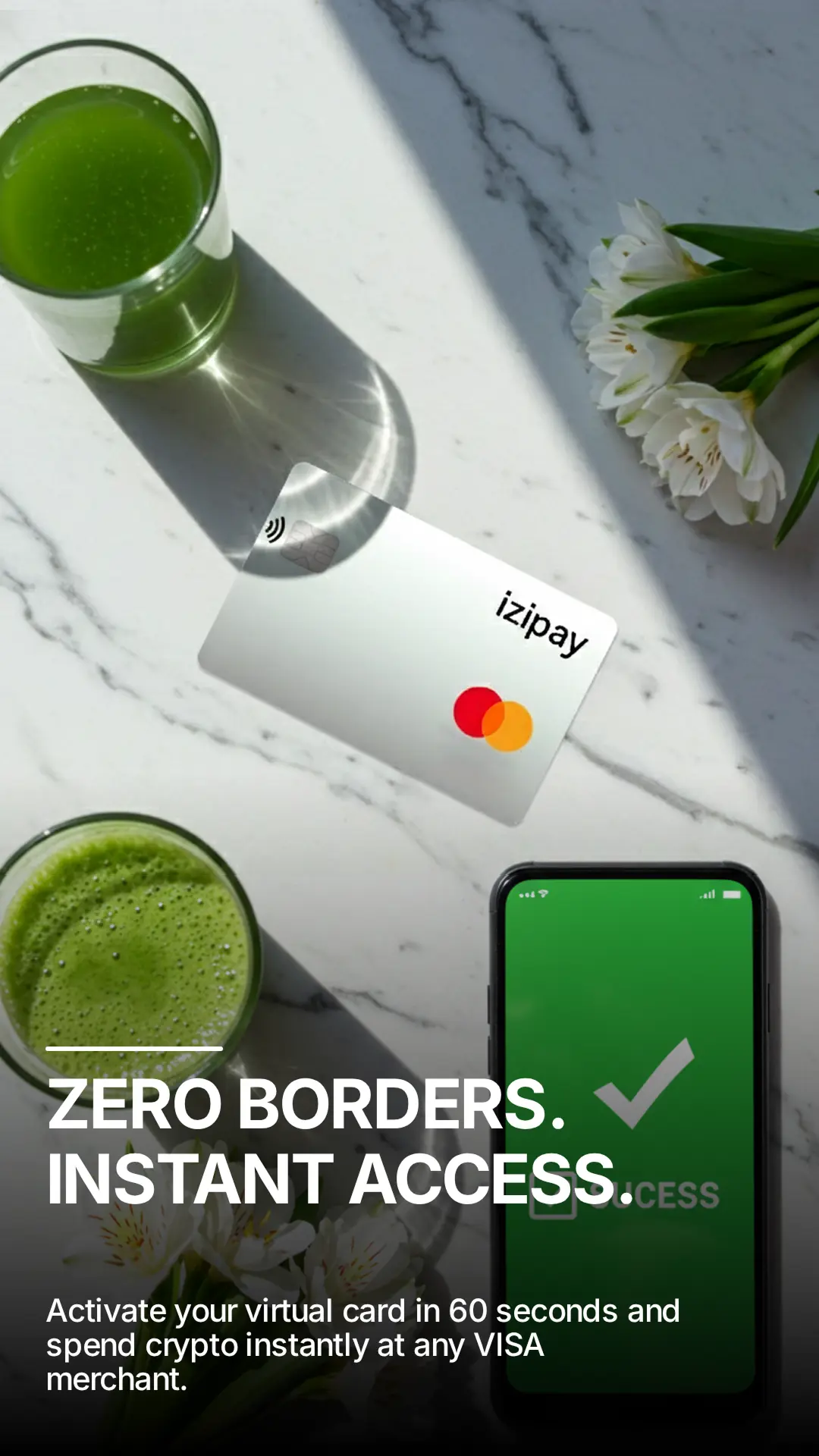
Quick answer: The best crypto card without KYC in 2026 is IZIPAY — a virtual Visa/Mastercard you open with just an email, top up with crypto (USDT, BTC, ETH, USDC, SOL, BNB), and add to Apple Pay or Google Pay in about two minutes. No passport, no selfie, no address proof.
What Is a No-KYC Crypto Card?
A no-KYC crypto card is a debit card linked to your cryptocurrency balance that doesn't require Know Your Customer (KYC) identity verification for standard use. Unlike traditional crypto cards from major exchanges, you don't need to upload your passport, record a selfie video, or prove your address.
These cards run on the standard Visa or Mastercard networks, so they're accepted at virtually any merchant online and in-store. The key difference: your identity stays private and the card is issued in minutes, not days.
No KYC vs Anonymous: Know the Difference
This is the distinction most articles skip, so let's be precise. "No KYC" describes the sign-up — the issuer doesn't collect your government ID to open the card. "Anonymous" describes the money trail — and no card is fully anonymous. Blockchain deposits are recorded on a public ledger, and merchants still see the name you type at checkout.
What a good no-KYC card gives you is practical privacy: your spending is not attached to a verified identity database that can be subpoenaed, sold, or leaked, and there's a clean layer of separation between your main wallet and the shops you use. For everyday needs — subscriptions, ads, shopping, travel — that is exactly the protection most people are actually looking for.
How No-KYC Crypto Cards Work
- You deposit crypto (USDT, Bitcoin, Ethereum, etc.) to your card account.
- The provider holds the balance and assigns you a Visa or Mastercard number.
- When you spend, the crypto is converted to fiat in real time.
- The merchant gets paid in ordinary currency — they never see crypto.
You can get a virtual card and pay with crypto here without any ID check.
No-KYC Crypto Card vs Exchange Cards (2026)
Most "crypto cards" from big exchanges are not no-KYC — they force full identity verification and can freeze your funds. Here's the honest difference:
| No-KYC card (IZIPAY) | Exchange card (Binance/Coinbase-style) | |
|---|---|---|
| ID / passport required | No | Yes — passport + selfie + address |
| Time to get the card | 2–3 minutes | 1–3 days (if approved) |
| Works if your country is unsupported | Yes | Often rejected |
| Can they freeze your balance for "review" | No | Yes |
| Funded with | Crypto only | Crypto, but tied to a verified account |
| Apple Pay / Google Pay | Yes | Sometimes |
What to Look For in a No-KYC Crypto Card
Not every card that skips ID checks is worth using. A cheap card on a "declined" BIN range will fail exactly when you need it — at the checkout for your ad account or AI subscription. Here's what separates a card you can rely on from one that wastes your top-up.
| What matters | Why it matters | What to want |
|---|---|---|
| Premium BIN | The first digits of the card decide which merchants accept it. Low-grade BINs get flagged as prepaid and declined by Google Ads, Netflix, Stripe checkouts. | A card on a premium bank BIN that clears strict merchants |
| Transparent fees | Hidden monthly, FX, and dormancy fees quietly drain the balance. | One clear top-up fee, no monthly charge |
| Stablecoin funding | Prices in USD stay predictable; you don't lose value to volatility between top-up and spend. | USDT / USDC funding, plus BTC/ETH if you want them |
| Virtual vs physical | Virtual is instant and disposable; physical adds ATM cash and in-store tap. | Both options from one account |
| Wallet support | Apple Pay / Google Pay means you can tap-to-pay and pass many online checks. | Native Apple Pay + Google Pay |
| Genuine no-KYC | Some "no-KYC" cards ask for ID the moment you top up more than $50. | Email-only sign-up with real usable limits |
On BINs specifically: this is the single most common reason a no-KYC card "doesn't work." IZIPAY issues cards on premium BINs chosen to clear demanding checkouts — Google and Facebook Ads, ChatGPT, Netflix, PayPal linking and more — so the card behaves like a normal bank card, not a throwaway prepaid.
Why Choose a Crypto Card Without KYC?
1. Privacy Protection
Your card statements reveal where you live, what you buy, and when. With a no-KYC card that data isn't tied to a verified identity database that can be subpoenaed, sold, or leaked.
2. Instant Setup
Traditional KYC takes 24–72 hours and can be rejected. A no-KYC crypto card is issued in 2–3 minutes with just an email.
3. Global Accessibility
If you live in a country where KYC processes reject your ID — much of Asia, Africa, the Middle East and Latin America — a no-KYC card is often your only viable way to pay for international services. It's a common choice in Pakistan, India, Turkey, Nigeria, Indonesia and beyond.
4. Avoid Identity Theft
Every KYC database is a target for hackers. By never uploading your documents, you remove yourself from that attack surface entirely.
5. No Bank Account Needed
A no-KYC crypto card works with no bank account — you fund it straight from your crypto wallet, which is why it's popular with freelancers, travellers and the unbanked. See our full walkthrough on getting a virtual card with no bank account.
Top 5 No-KYC Crypto Cards in 2026
| Provider | Virtual | Physical | Apple Pay | Cryptos |
|---|---|---|---|---|
| IZIPAY ⭐ | $49.99 | $459.99 | ✓ | BTC, ETH, USDT, USDC, SOL, BNB |
| Provider A | $79 | $199 | ✓ | BTC, ETH |
| Provider B | $120 | $299 | ✗ | USDT |
| Provider C | $60 | N/A | ✓ | BTC, USDT |
| Provider D | $199 | $599 | ✓ | BTC, ETH, USDT |
Why IZIPAY Stands Out
- Lowest virtual card price for a genuinely no-KYC service
- Premium BINs that clear strict merchants and ad platforms
- Widest crypto support — 6 cryptocurrencies across 6 networks
- Apple Pay + Google Pay ready in about 2 minutes
- Premium physical metal card for ATM withdrawals
- 38-language support for global accessibility
Virtual vs Physical: Which Should You Get?
A virtual card is the right choice for most people. It's issued instantly, it's perfect for online subscriptions and ad accounts, and if a number is ever compromised you simply spin up another. A physical metal card adds real-world power: contactless tap in stores and ATM cash withdrawals when you're travelling. Many users keep a virtual card for the internet and a physical card in their pocket — both live under the same no-KYC account.
What Fees Do You Actually Pay?
Transparency matters. With IZIPAY there are exactly two costs and no hidden monthly fee:
- One-time card issue: $49.99 for a virtual card (or $459.99 for the physical metal card).
- Top-up fee: a flat 3% when you load crypto onto the card. That's it — $0 monthly, no dormancy charges, and no FX surprises for USD spending.
See the full breakdown on the pricing page.
Is a No-KYC Crypto Card Safe and Legit?
A fair question — the internet is full of prepaid scams. Here's how to judge legitimacy, and how IZIPAY measures up:
- Real card network. A legit card carries a genuine Visa or Mastercard number that works everywhere those networks are accepted — not a closed-loop voucher.
- Wallet tokenisation. If it loads into Apple Pay and Google Pay, it has passed the network's device-provisioning checks. IZIPAY does.
- No surprise ID wall. A trustworthy no-KYC service is upfront about what it does and doesn't collect, and doesn't ambush you with a passport request after you've paid.
- Clear, single fee. Predictable pricing (a flat top-up fee, no monthly drain) is a sign of an honest operator.
- You control the top-up. You decide how much crypto to load, so your exposure is only ever the balance on the card — never a linked bank account.
For a broader community perspective on what works and what to avoid, this no-KYC crypto card Reddit guide collects real user experiences.
How Anonymous Is a No-KYC Card, Really?
Let's be honest — this is the question that matters. A no-KYC card means the card issuer doesn't collect your government ID. It does not make blockchain transactions untraceable, and merchants still see the name you type at checkout. What you get:
- No passport, selfie, or proof-of-address on file with the issuer.
- Your spending isn't linked to a verified KYC identity database.
- A layer of separation between your main crypto wallet and the merchant.
For everyday privacy — subscriptions, ads, shopping, travel — that's exactly the protection most people want. For strict legal compliance in your jurisdiction, always check local rules. If full anonymity is your goal, compare the tradeoffs in our anonymous crypto debit card best options breakdown.
Best No-KYC Card by Use Case
A no-KYC crypto card shines anywhere a normal card is declined or where you'd rather not verify:
- AI subscriptions — pay for AI tools with crypto, including Claude, ChatGPT Plus, Midjourney and Perplexity.
- Ad accounts — fund Facebook, Google and TikTok Ads with a crypto card without a bank.
- Streaming — Netflix, Spotify, Disney+, YouTube Premium.
- Privacy tools — NordVPN, ProtonMail, Mullvad.
- Travel & shopping — Booking.com, Airbnb, Amazon, eBay, AliExpress.
- Adult & anonymous — pay for OnlyFans anonymously.
Browse everything you can pay for with crypto.
How to Get Your No-KYC Crypto Card
Step 1: Register with Email Only
Visit izipay.me/register. Email + password only — no ID.
Step 2: Choose Your Card
Virtual ($49.99) or Physical Metal ($459.99).
Step 3: Pay with Crypto
Deposit USDT, BTC, ETH, SOL, BNB, or USDC. Confirms in 1–5 minutes.
Step 4: Instant Activation
Card details appear immediately. Add to Apple Wallet or Google Wallet.
Step 5: Spend Anywhere
Netflix, ChatGPT, Amazon, hotels, restaurants — and ATMs with the physical card.
Common Mistakes to Avoid
- Confusing exchange cards with no-KYC cards. If it asks for a passport, it isn't no-KYC.
- Ignoring the BIN. A budget card on a flagged BIN gets declined at the checkouts you care about — choose a premium BIN.
- Underfunding the card. Top up a little extra so fees don't leave you short at checkout.
- Using a volatile coin for exact amounts. Stablecoins (USDT/USDC) keep the value predictable.
- Choosing the wrong network. USDT on TRC-20 is the cheapest to send.
Conclusion
A no-KYC crypto card isn't just convenient — it's a statement. You shouldn't need to surrender your identity to spend your own money.
IZIPAY delivers privacy, speed, premium BINs, and global access. With virtual cards at $49.99, a flat 3% top-up, $0 monthly, instant activation, and full Apple Pay support, it's the smartest crypto card without KYC in 2026.
Get your no-KYC card now at izipay.me →
Related Guides
- No-KYC Virtual Crypto Card: Spend Crypto Without ID (2026)
- Anonymous Crypto Debit Card: 7 Best (2026)
- Virtual Card With No Bank Account
- No-KYC Crypto Card — Reddit Guide
- Pay for AI Tools With Crypto
- Apply for a Digital Currency Card (2026 Guide)
- How to Pay for OnlyFans Anonymously with Crypto in 2026
Want a Bitcoin-specific option? Read about the Bitcoin debit card with no verification.
New to this? Start with our step-by-step guide: how to get a no-KYC crypto card.
See also: How to Pay for Anything with Crypto (No-KYC Card)
Ready to get a no-KYC crypto card? Create your anonymous virtual card now → — no ID, no bank account, funded with crypto and ready in minutes.